

I was given a mug at a very young age, I believe it was at my fourth birthday – I don’t remember for sure on the mug, but I know that’s the birthday that I was given a small hammer. Sheila gave me a small hammer with a wooden handle and a steel head, so that even at a young age I owned a creative tool of my very own.
Anyway, whether or not it was that birthday or another, I had this mug as a child and it was significant to me because it was “real”, it was not a toy, it was not for pretending – it was the real deal and it was mine. I remember a schooner on the mug, in hues of blue and golden, with billowing sails making it look magnificent to me. I spent some time staring closely at the portrait, looking for any sign of the slightest movement in the sails or the surf, and wondering if it was the Dawn Treader. I thought that perhaps it would come to life, and like Eustice, Lucy, and Edmund, this was my way into Narnia.
That mug never came to life, but it did give me a special place for mugs in my heart, and Sleepytime tea was my favorite brew to drink. I later learned to appreciate a few other flavors, and brands, but Celestial Seasonings Sleepytime was always the golden standard.
I purchased a few household items during my stay in Moscow Idaho, not enough to fill a kitchen, but enough for my needs. As a college student I also was quite frugal, and buying new things seemed completely unnecessary, so I did as much shopping as I could at the second hand stores. I remember picking out a plate, a bowl, and a few utensils and then seeing a shelf full of mugs. Each mug had a personality, had a slightly different shape, or handle, or finish, and they were so cheap that I considered buying several of them. I finally settled on two sturdy looking mates, with nice thick walls and simple decor of stars.
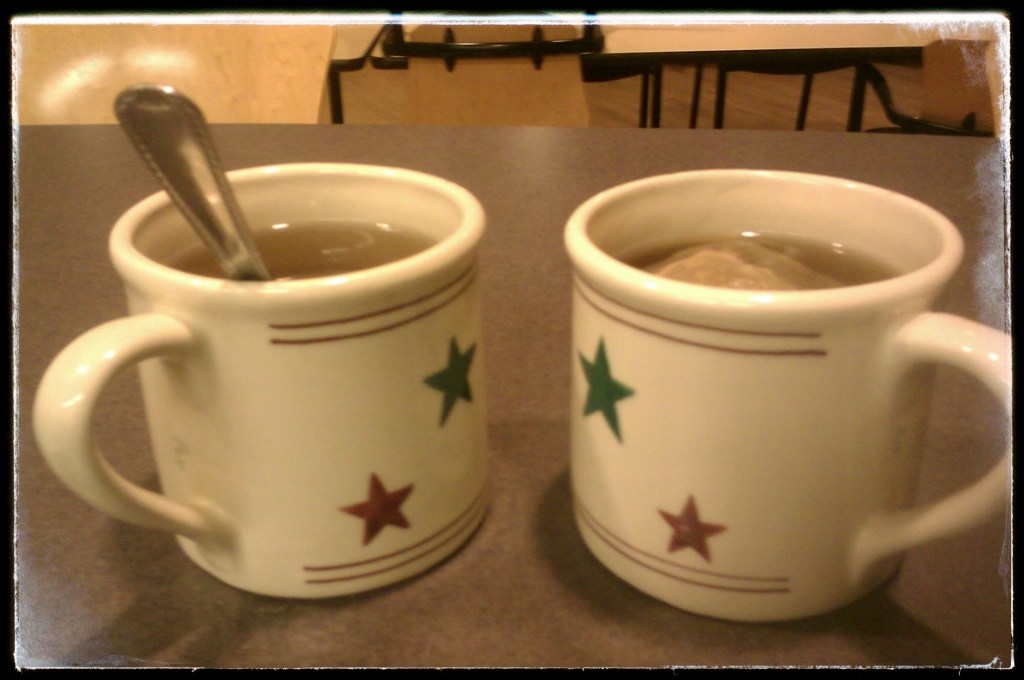
As Moscow was exceedingly cold and snowy, hot tea was always a welcome addition to any evening, and these thick mugs let you keep your hands warm for a good long time without being scalded. They were ideal, and because I had two of them, I would often share the evening tea-time with a friend. In this case, I was on-call and stuck in my dorm. It was a quiet evening inside the dorm, with a cold wind outside and not much else happening. I was restless and felt a great weight that evening. I sent this picture to a friend as an invitation, and they actually came over and spent some time with me.
I had forgotten about these mugs, and I had forgotten about that evening – but last month the Google photos AI reminded me of a picture taken the same week as this one was, both of them now nearly a decade ago. When I went to look at the memory, I saw this photo of the mugs and remembered that evening. That memory looks quite different to me now, than it did while I was in it.
Later that year, when I was back in Ohio for Christmas, Sheila offered me a cup of tea one evening, in a legit Sleepytime mug. It had the picture of the cozy bears on it, and it made the tea taste just that much better. I exclaimed at how wonderful a mug and asked her how I could get one like that myself – and right then and there she gave it to me.
Sheila has passed on, and that Sleepytime mug she gave me was shattered a handful of years ago. That friend that visited me that evening, we rarely ever talk anymore.
Just this past week, my sister texted the family some pictures of her new cute apartment in Georgia. In one of her pics, hanging on a rack, I saw a thick mug with stars and recognized it as one of same ones I had bought all those years ago, and had been recently reminded of when reviewing old photos. I’ve changed so much since that restless November night, and yet I still feel grateful at the memory of a friend taking their time to come visit me.
Don’t let the fear of what will yet be, or the shame of what once was, keep you from connecting, from sharing your life with others.
 A Flavor In-Between